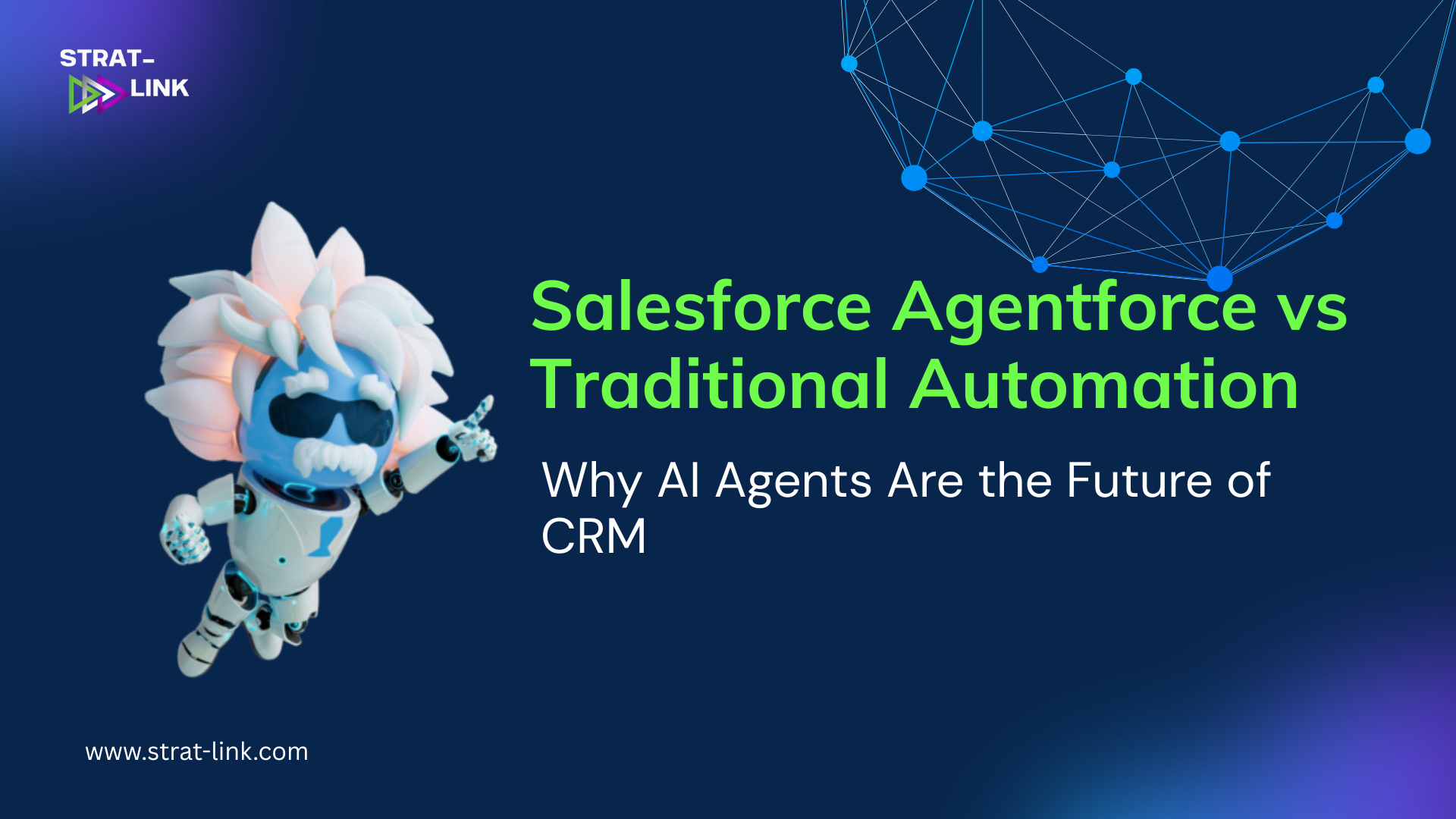
Salesforce Agentforce vs Traditional Automation: Why AI Agents Are the Future of CRM
Introduction to the Changing CRM Landscape
Customer Relationship Management is undergoing a profound metamorphosis. What was once a system of record has now become a system of intelligence. Enterprises are no longer satisfied with storing customer data – they demand systems that can interpret, predict, and act.
This shift is not incremental. It is tectonic.
The emergence of Salesforce Agentforce marks a pivotal moment in this evolution, redefining how businesses interact with customers, automate processes, and drive growth.
The Evolution of CRM: From Static Systems to Intelligent Platforms
CRM systems began as digital repositories. They stored contacts, tracked interactions, and facilitated basic reporting. Over time, automation features were introduced to streamline repetitive tasks.
However, these systems remained inherently static. They followed predefined rules and lacked the ability to adapt.
Today, CRM platforms are transitioning into intelligent ecosystems. They leverage artificial intelligence to deliver insights, automate decisions, and orchestrate experiences in real time.
Understanding Traditional Automation in CRM
Rule-Based Workflows and Their Limitations
Traditional automation operates on deterministic logic. If a condition is met, a predefined action is triggered.
This approach is predictable but rigid. It cannot accommodate ambiguity or adapt to evolving scenarios. As business environments become more dynamic, these limitations become increasingly apparent.
Process Builders and Legacy Automation Tools
Tools like workflow rules and process builders were revolutionary in their time. They enabled organizations to automate approvals, notifications, and basic processes.
However, they require constant maintenance. Each new scenario demands additional rules, leading to complexity and inefficiency.
Where Traditional Automation Still Works
Despite its limitations, traditional automation retains value in structured environments. Routine processes with clear parameters can still benefit from rule-based systems.
Yet, its applicability diminishes in scenarios requiring contextual understanding or dynamic decision-making.
What Is Salesforce Agentforce?
The Concept of AI Agents in CRM
Salesforce Agentforce introduces a paradigm shift. Instead of static workflows, it deploys AI agents – autonomous entities capable of understanding context, making decisions, and executing tasks.
These agents function as digital co-workers. They learn continuously, adapt to new information, and operate with minimal human intervention.
How Agentforce Works Within the Salesforce Ecosystem
Agentforce integrates seamlessly with Salesforce’s ecosystem, leveraging data from across clouds to deliver unified intelligence.
It acts as an orchestration layer, connecting data, processes, and interactions into a cohesive framework.
Key Capabilities of Agentforce
Agentforce is characterized by its ability to analyze vast datasets, predict outcomes, and execute actions autonomously.
It transcends automation by introducing cognition into workflows, enabling systems to think, not just act.
Salesforce Agentforce vs Traditional Automation: Core Differences
Static Logic vs Adaptive Intelligence
Traditional automation relies on fixed rules. Agentforce, on the other hand, adapts dynamically.
It learns from data, refines its models, and evolves over time. This adaptability is a defining advantage.
Reactive Systems vs Proactive Decision-Making
Legacy systems react to triggers. Agentforce anticipates needs.
It identifies opportunities and risks before they materialize, enabling proactive interventions.
Workflow Automation vs Autonomous Execution
Automation executes predefined tasks. Agentforce executes outcomes.
It determines the best course of action and carries it out, reducing the need for manual oversight.
The Rise of AI Agents in CRM
From Assistance to Autonomy
AI in CRM began as an assistive tool, offering recommendations and insights.
Agentforce elevates this to autonomy. AI agents can now execute tasks independently, transforming the role of CRM systems.
Continuous Learning and Context Awareness
AI agents are not static. They learn continuously from interactions and outcomes.
This enables them to understand context, adapt strategies, and improve performance over time.
Human-AI Collaboration
Rather than replacing humans, AI agents augment their capabilities.
They handle repetitive and data-intensive tasks, allowing human professionals to focus on strategic initiatives.
Deep Dive: Key Features of Salesforce Agentforce
Natural Language Processing and Conversational Interfaces
Agentforce leverages advanced natural language processing to facilitate intuitive interactions.
Users can communicate with the system in conversational language, reducing complexity and enhancing usability.
Real-Time Decision Engines
Real-time decision-making is a cornerstone of Agentforce.
It analyzes data instantaneously, enabling immediate responses to changing conditions.
Autonomous Task Execution
Agentforce can execute tasks without human intervention.
From lead qualification to case resolution, it handles processes end-to-end.
Multi-Channel Intelligence
Modern customer interactions span multiple channels.
Agentforce integrates data from these channels, providing a unified view and enabling consistent experiences.
Limitations of Traditional Automation
Lack of Contextual Awareness
Traditional systems operate without context.
They cannot interpret nuances or adapt to changing circumstances, leading to suboptimal outcomes.
Scalability Constraints
As businesses grow, rule-based systems become increasingly complex.
Managing and scaling these systems becomes a significant challenge.
Maintenance Overhead
Maintaining traditional automation requires constant updates.
This consumes resources and limits agility.
Business Impact of Agentforce
Enhanced Customer Experience
Agentforce enables personalized, real-time interactions.
Customers receive relevant recommendations and timely support, enhancing satisfaction.
Increased Operational Efficiency
By automating complex processes, Agentforce reduces operational overhead.
This leads to faster execution and improved productivity.
Revenue Acceleration
AI-driven insights enable better decision-making.
This translates into higher conversion rates and increased revenue.
Use Cases: Agentforce in Action
Sales Enablement
Agentforce identifies high-potential leads, recommends actions, and automates follow-ups.
Sales teams can focus on closing deals rather than managing data.
Marketing Automation Reinvented
Marketing becomes more precise and dynamic.
Agentforce personalizes campaigns, optimizes timing, and enhances engagement.
Customer Service Transformation
AI agents resolve queries, route cases, and provide instant support.
This reduces response times and improves customer satisfaction.
Field Service Optimization
Agentforce optimizes scheduling, predicts maintenance needs, and enhances service delivery.
This leads to improved efficiency and reduced downtime.
Data as the Foundation of AI Agents
Data is the lifeblood of AI agents.
Agentforce relies on high-quality, unified data to deliver accurate insights and actions. Without robust data governance, its effectiveness diminishes.
Security and Governance in AI-Driven CRM
Security is paramount in AI-driven systems.
Agentforce incorporates advanced security measures to protect data and ensure compliance.
Governance frameworks ensure ethical and responsible use of AI.
Integration with Existing Salesforce Clouds
Agentforce integrates seamlessly with Sales Cloud, Service Cloud, Marketing Cloud, and beyond.
This creates a unified ecosystem where data and processes flow seamlessly.
The Role of Generative AI in Agentforce
Generative AI enhances Agentforce’s capabilities.
It enables content creation, conversational interactions, and advanced analytics, further expanding the potential of CRM systems.
Challenges in Adopting AI Agents
Adopting Agentforce is not without challenges.
Organizations must address data quality, integration complexities, and skill gaps to fully realize its potential.
Change Management and Organizational Readiness
Successful adoption requires cultural transformation.
Employees must embrace new ways of working and adapt to AI-driven processes.
Future Trends: The Autonomous CRM Era
The future of CRM is autonomous.
Systems will not only support decisions but also execute them, creating a new paradigm of business operations.
Why Enterprises Must Shift to Agentforce Now
The competitive landscape is evolving rapidly.
Enterprises that adopt Agentforce gain a significant advantage, while those that delay risk falling behind.
Conclusion: The End of Traditional Automation?
Traditional automation is not obsolete, but its relevance is diminishing.
Agentforce represents the future – a future defined by intelligence, autonomy, and adaptability.
The question is no longer whether to adopt AI agents, but how quickly it can be done.
Transform Your CRM Strategy with STRAT-LINK
The shift from traditional automation to AI-driven CRM requires expertise and precision.
STRAT-LINK empowers businesses to implement Salesforce Agentforce seamlessly, unlocking the full potential of AI agents.
From strategy to execution, STRAT-LINK delivers transformative outcomes.
Ready to redefine your CRM? Connect with STRAT-LINK today and lead the future of intelligent customer engagement.
FAQs
What is Salesforce Agentforce?
Salesforce Agentforce is an AI-driven platform that uses autonomous agents to automate processes, make decisions, and enhance customer interactions.
How is Agentforce different from traditional automation?
Agentforce uses adaptive intelligence and autonomous execution, whereas traditional automation relies on static, rule-based workflows.
Can Agentforce replace human roles?
Agentforce augments human capabilities rather than replacing them, enabling teams to focus on strategic tasks.
Is Agentforce secure?
Yes, it incorporates advanced security measures and governance frameworks to ensure data protection and compliance.
How can businesses implement Agentforce?
Businesses should start with a clear strategy, ensure data readiness, and partner with experts like STRAT-LINK for successful implementation.