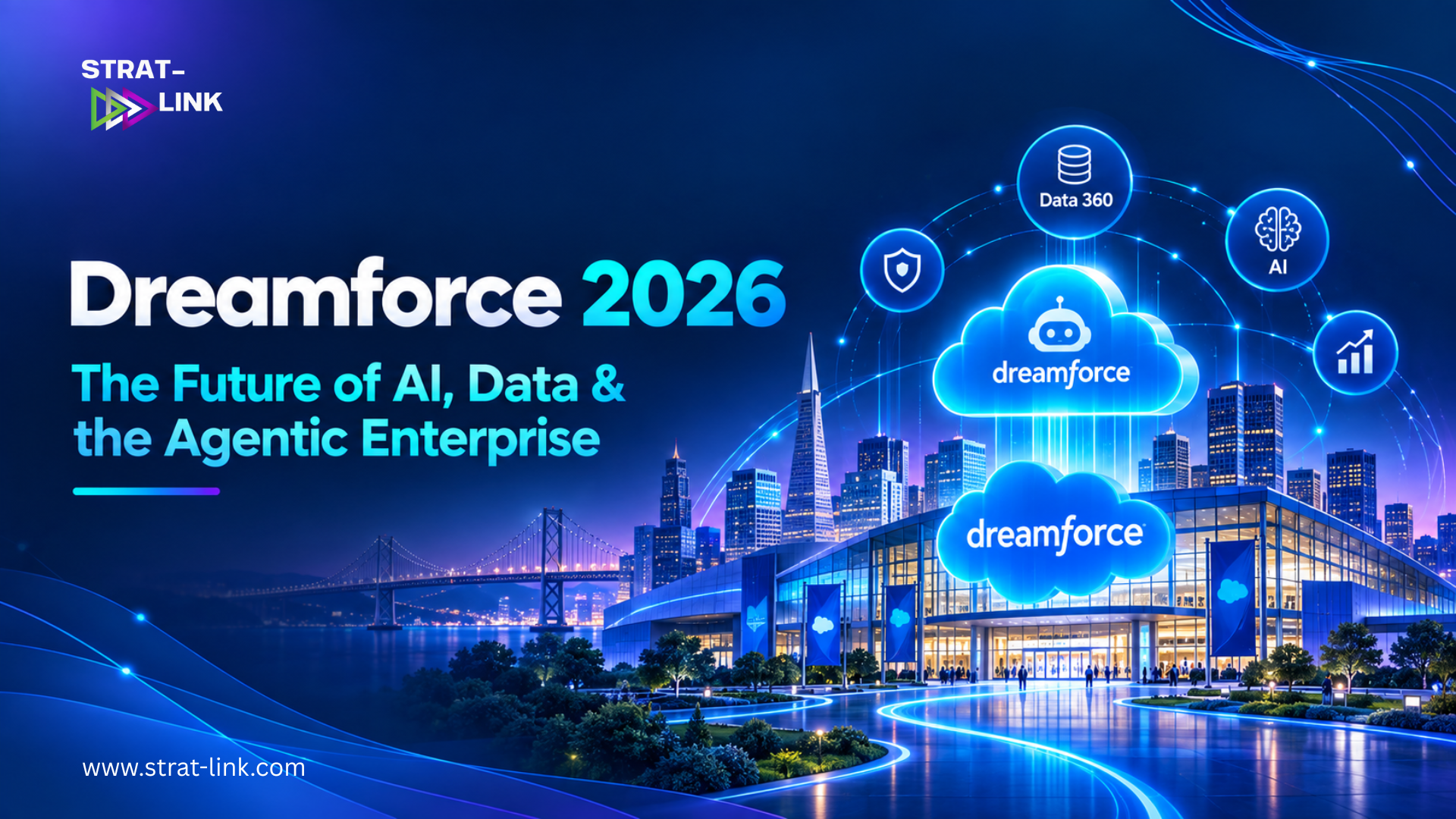
Dreamforce 2026: What Salesforce’s Biggest Event Means for the Future of AI and Business
AI is no longer simply changing the software businesses use.
It is changing how businesses operate, make decisions, serve customers, and scale.
That shift is at the heart of Dreamforce 2026, Salesforce’s flagship annual event taking place September 15–17, 2026, at Moscone Center in San Francisco, with the experience also available through Salesforce+.
This year’s Dreamforce is built around a clear idea: the Agentic Enterprise – organizations where humans and AI agents work together to transform how business gets done.
For Salesforce customers, technology leaders, CIOs, marketers, sales teams, developers, and business decision-makers, Dreamforce 2026 is more than another product event. It offers a view into where enterprise technology is heading next.
And for organizations evaluating Salesforce, AI, data modernization, automation, cybersecurity, or digital transformation, the announcements and conversations coming out of Dreamforce deserve close attention.
What Is Dreamforce 2026?
Dreamforce is Salesforce’s annual global gathering for its customers, partners, developers, administrators, marketers, business leaders, and wider Trailblazer community.
The 2026 edition runs from September 15 to September 17 in San Francisco, alongside a digital experience on Salesforce+.
The scale is significant:
- 1,600+ breakout sessions
- 50+ visionary and product keynotes
- 150+ hands-on trainings and demos
- 240+ community roundtables
- Product and industry experiences spanning Salesforce’s expanding technology ecosystem
But numbers alone do not explain why Dreamforce 2026 matters.
The real story is the transition from traditional business automation toward an agent-powered enterprise model.
The Biggest Theme at Dreamforce 2026: The Agentic Enterprise
The phrase “Agentic Enterprise” is everywhere in Salesforce’s Dreamforce 2026 positioning.
The idea goes beyond using AI to generate content or answer questions.
An agentic enterprise uses AI agents to understand context, reason over trusted information, take actions, collaborate with employees, and contribute to business processes.
Salesforce describes the vision as an environment where businesses can transform every part of their operations with humans and agents working together.
This represents an important evolution.
Traditional automation typically follows predefined rules:
Trigger → Rule → Action
AI-powered agents can move toward:
Understand → Reason → Decide → Act → Learn from context
That difference can have major implications for customer service, sales, marketing, operations, IT, employee productivity, and decision-making.
For businesses, the question is therefore no longer simply:
“Where can we automate?”
It becomes:
“Where can intelligent agents safely take responsibility for business outcomes?”
That is a much bigger transformation.
Agentforce: Moving From AI Assistance to Business Action
One of the central themes of Dreamforce 2026 is Agentforce.
Salesforce’s Agentforce vision focuses on creating AI agents that can operate within business workflows while being grounded in enterprise data and business context.
The Agentforce keynote at Dreamforce 2026 specifically focuses on moving from quick starts to real ROI, including starting with out-of-the-box agents, customizing them for specific business outcomes, and grounding them in customer context and data.
This is an important message for organizations exploring AI.
Building an AI chatbot is relatively easy.
Building an AI agent that can reliably work inside a complex enterprise environment is much harder.
The real requirements include:
- High-quality enterprise data
- Clear business processes
- Strong security controls
- Defined permissions
- Governance
- Integration across systems
- Reliable context
- Human oversight where necessary
- Measurable business outcomes
That means successful Agentforce adoption is not simply an AI implementation exercise.
It is an enterprise transformation exercise.
Data 360: Why Context Is Becoming the AI Advantage
One of the most important messages coming from Dreamforce 2026 is that AI alone is not enough.
The quality and availability of enterprise context matter.
Salesforce’s Data 360 keynote is built around the idea that trusted enterprise context can become an AI advantage. Salesforce positions Data 360 as a way to provide humans and agents with real-time context to improve customer engagement, AI efficiency, and trusted AI deployment.
This is critical because enterprises often have data spread across multiple platforms.
Customer information may exist in CRM.
Marketing engagement data may sit in marketing platforms.
Product information may live in other applications.
Service interactions may exist in separate systems.
Analytics and operational data may be distributed across additional sources.
AI cannot deliver reliable business outcomes if it is working with fragmented or outdated information.
This makes data modernization one of the foundations of the agentic enterprise.
In practical terms:
Better data → Better context → Better AI decisions → Better business outcomes
That is why Salesforce’s continued emphasis on Data 360 is strategically significant.
AIforce and the Next Generation of Enterprise AI
Dreamforce 2026 also introduces an expanded focus on AIforce, with Salesforce positioning it around bringing AI into the places where people and agents work.
The AIforce keynote highlights the combination of AI, trust, ROI, and Headless 360, demonstrating how organizations can build their agentic enterprise.
The broader message is clear.
Enterprise AI cannot exist in isolation.
It needs to be connected to:
- Business applications
- Enterprise data
- Employees
- Customers
- Workflows
- Security
- Governance
- Collaboration platforms
This is where the distinction between an AI experiment and an enterprise AI strategy becomes increasingly important.
Slack Is Becoming More Than a Collaboration Tool
Another major Dreamforce 2026 theme is Slack’s role in the agentic enterprise.
Salesforce’s Slack keynote positions Slack as a front door to the agentic enterprise, with AI becoming part of how teams work and Slackbot acting as an employee-facing superagent.
This points toward a future in which employees do not necessarily need to switch between multiple applications to complete every task.
Instead, AI can increasingly bring information, recommendations, actions, and workflows into the employee’s working environment.
For organizations, this can have a direct impact on productivity.
The opportunity is not simply “adding AI to Slack.”
It is creating a more connected operating model where employees and agents can collaborate around real-time business context.
Claudeforce: Salesforce and Anthropic Bring Enterprise AI Together
Another significant development at Dreamforce 2026 is the focus on the Salesforce and Anthropic partnership.
Salesforce’s Dreamforce program features Anthropic co-founder and CEO Dario Amodei alongside Marc Benioff to discuss the Claudeforce partnership and how Claude’s advanced reasoning can work with trusted Salesforce data.
This is an important signal for enterprise technology leaders.
The future of enterprise AI is unlikely to be defined by one model, one application, or one vendor.
Organizations will increasingly need to determine:
- Which models are appropriate for which workloads?
- How should enterprise data be protected?
- How should AI outputs be governed?
- How should different AI systems interact with business applications?
- How can organizations measure AI ROI?
- How can AI remain trustworthy at enterprise scale?
The Salesforce-Anthropic direction reflects the growing importance of connecting advanced AI reasoning with trusted enterprise context.
Security and Trust Cannot Be an Afterthought
As AI agents gain the ability to perform actions, cybersecurity becomes even more important.
A traditional software application may process information.
An AI agent can potentially interpret information and act on it.
That creates a different risk profile.
Organizations implementing agentic systems need to consider:
- Identity and access management
- Data permissions
- Agent authorization
- Sensitive information protection
- Auditability
- Human oversight
- Prompt and model security
- Compliance
- Monitoring and governance
Salesforce has also placed Trusted AI and Security prominently within its Dreamforce 2026 experience, alongside Agentforce and Data 360.
For businesses, this is a crucial lesson:
The goal should not be to deploy the most AI possible.
The goal should be to deploy useful, secure, governed AI that creates measurable value.
What Dreamforce 2026 Means for Businesses
For business and technology leaders, the most important takeaway from Dreamforce 2026 is not any single feature announcement.
It is the direction of the platform.
Salesforce is moving toward an ecosystem where:
CRM + Data + AI + Agents + Automation + Collaboration + Trust
work together as part of a broader enterprise architecture.
That creates opportunities across virtually every function.
Sales
AI agents can support lead qualification, research, follow-ups, opportunity intelligence, and sales productivity.
Marketing
AI can help marketers move toward more personalized customer journeys, faster campaign execution, intelligent segmentation, and autonomous decision-making.
Customer Service
Agents can assist customers, resolve routine requests, surface context, and support service teams.
IT
AI can help teams accelerate development, troubleshoot issues, manage workflows, and improve employee productivity.
Operations
Agents can help orchestrate repetitive processes and connect information across business systems.
Leadership
Executives can gain more connected intelligence across customers, employees, operations, and business performance.
The opportunity is substantial.
But organizations will need a clear strategy before scaling.
How Should Businesses Prepare for the Agentic Enterprise?
Dreamforce 2026 should not end as a three-day event that produces a long list of exciting ideas.
The real value comes from translating those ideas into an actionable roadmap.
Here are five areas organizations should evaluate.
1. Audit Your Data Foundation
Identify where customer and operational data lives.
Look for duplication, fragmentation, outdated information, disconnected systems, and governance gaps.
2. Identify High-Value Agent Opportunities
Do not start with “Where can we use AI?”
Start with:
Which business processes are slow, repetitive, expensive, or heavily dependent on manual decisions?
Those are often stronger candidates for agentic transformation.
3. Establish AI Governance
Define who can access what data, what agents can do, what actions require approval, and how decisions will be monitored.
4. Connect AI to Business Outcomes
AI adoption should be measured against meaningful KPIs.
Examples include:
- Revenue growth
- Conversion rates
- Customer satisfaction
- Service resolution time
- Employee productivity
- Marketing performance
- Cost reduction
5. Build for Scale
An AI pilot may work in isolation.
Enterprise AI needs to work across systems, teams, security policies, data environments, and business processes.
That requires thoughtful architecture and experienced implementation.
Why Dreamforce 2026 Matters Beyond Salesforce
Dreamforce has historically been a major Salesforce event.
But its significance now extends beyond CRM.
The themes being showcased – AI agents, trusted data, enterprise AI, automation, collaboration, security, and human-agent collaboration – represent broader changes happening across the technology industry.
Businesses are moving from:
Systems that help employees work
to:
Systems where employees and intelligent agents work together.
That is a fundamental shift.
Organizations that begin preparing now can build the data, architecture, governance, and skills needed to take advantage of it.
Those that treat AI as another isolated technology project may struggle to capture the same value.
FAQ
These questions are particularly useful for capturing Google featured snippets, AI search answers, and People Also Ask-style queries.
What is Dreamforce 2026?
Dreamforce 2026 is Salesforce’s annual global technology event taking place September 15–17, 2026, in San Francisco and through Salesforce+. It focuses heavily on the Agentic Enterprise, Agentforce, Data 360, AI, Slack, trusted AI, and enterprise transformation.
When is Dreamforce 2026?
Dreamforce 2026 takes place from September 15 to September 17, 2026, at Moscone Center in San Francisco, with digital access available through Salesforce+.
What is the main theme of Dreamforce 2026?
The central theme is the Agentic Enterprise, where humans and AI agents work together to transform business operations and customer experiences.
What is Agentforce at Dreamforce 2026?
Agentforce is Salesforce’s platform for building and deploying AI agents that can work within business processes. Dreamforce 2026 emphasizes moving from initial AI deployments toward customized agents, trusted context, and measurable ROI.
Why is Data 360 important for AI?
Data 360 provides trusted enterprise context that can help humans and AI agents make better-informed decisions. Salesforce is positioning unified, trusted data as a key advantage for enterprise AI.
How can businesses prepare for the Agentic Enterprise?
Businesses should strengthen their data foundation, identify high-value AI use cases, establish governance and security controls, connect AI initiatives to measurable KPIs, and build an architecture capable of scaling across business systems.
Is Dreamforce 2026 available online?
Yes. Salesforce is providing a digital Dreamforce experience through Salesforce+, including streamed sessions, keynotes, training, and on-demand content.
What does Dreamforce 2026 mean for businesses?
Dreamforce 2026 signals a broader shift toward AI-powered enterprises where intelligent agents, trusted data, automation, business applications, collaboration tools, and human employees operate as a connected ecosystem.
Final Thoughts: From Dreamforce 2026 to Real-World Transformation
Dreamforce 2026 represents an important moment for Salesforce and the wider enterprise technology ecosystem.
With more than 1,600 sessions, 50+ keynotes, 150+ hands-on trainings, and 240+ community roundtables, the event brings together an enormous range of ideas, technologies, experts, and customer experiences.
But the biggest takeaway may be much simpler:
AI is moving from assistance to action.
The organizations that benefit most will not necessarily be those that adopt the most AI tools.
They will be the ones that build the right foundation – trusted data, secure architecture, strong governance, connected systems, and clearly defined business outcomes – and then put AI agents to work where they can create measurable value.
At STRAT-LINK, we believe technology transformation should always be connected to business impact.
As Salesforce, Agentforce, Data 360, AIforce, Slack, and enterprise AI continue to evolve, organizations need more than technology awareness. They need a practical roadmap for turning innovation into secure, scalable, real-world outcomes.
Dreamforce 2026 is setting the stage for the next chapter of enterprise technology.
Here’s to a successful Dreamforce 2026 – and to the innovators, Trailblazers, developers, business leaders, and technology teams shaping what comes next.
Wishing Salesforce and the entire global Trailblazer community a highly successful Dreamforce 2026.
Ready to turn the latest Salesforce and AI innovations into a practical business strategy?
Connect with STRAT-LINK to explore Salesforce consulting, AI transformation, cybersecurity, technology modernization, and skilled staffing solutions designed around your business goals.