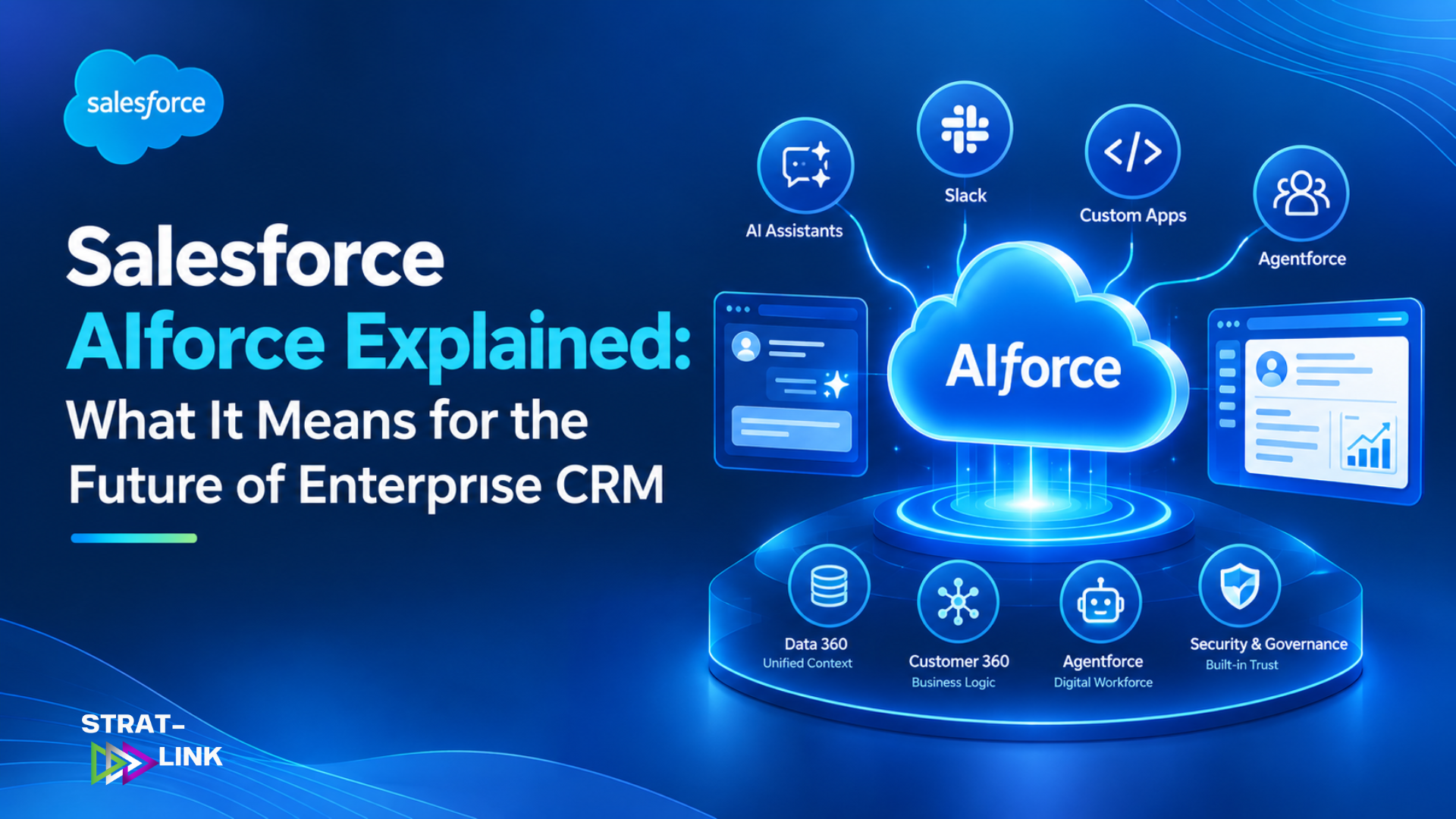
Salesforce AIforce: What It Means for the Future of Enterprise CRM
Salesforce is entering a new phase of enterprise software – one where the CRM is no longer confined to its own interface.
The latest development is AIforce, Salesforce’s new “live interface” layer designed to bring Salesforce data, business logic, workflows, permissions, and intelligence into the interfaces where people and AI agents already work.
That distinction matters.
AIforce is not simply another AI assistant, chatbot, or CRM feature. Salesforce describes it as a way to make the capabilities already inside Salesforce available across AI interfaces, applications, collaboration tools, and other experiences.
For enterprises that have spent years building Salesforce as a system of record, system of engagement, and increasingly a system of intelligence, AIforce could represent the next logical evolution: Salesforce becomes less of a destination and more of an intelligent enterprise layer.
Below is a practical look at what AIforce means, how it works, where it fits with Agentforce and Data 360, and why it could reshape enterprise CRM architecture.
1. What Is Salesforce AIforce?
AIforce is Salesforce’s approach to bringing Salesforce capabilities to the interface where work actually happens.
Salesforce describes AIforce as a “live interface” that can bring together Salesforce data, applications, workflows, business context, permissions, and intelligence across different interfaces.
This is an important distinction.
AIforce is not simply another application that employees need to open.
Instead, Salesforce is attempting to make the platform accessible through other AI tools, collaboration environments, applications, and custom interfaces.
In September 2026, Salesforce also noted that Headless 360 had been rebranded as AIforce, with the underlying functionality and content remaining unchanged during the transition.
In practical terms, the idea is simple:
Wherever work happens, Salesforce capabilities can come with it.
2. Why AIforce Matters Now
Enterprise software historically worked around applications.
Employees opened Salesforce to manage opportunities.
They opened a service console to resolve cases.
They opened marketing platforms to manage campaigns.
They moved between systems because the applications were the destinations.
AI is changing that behavior.
People increasingly interact with software through conversational interfaces, AI assistants, embedded applications, collaboration platforms, and autonomous agents.
That creates a new architectural question:
If the user interface is no longer fixed, where does enterprise intelligence live?
Salesforce’s answer is increasingly centered on the underlying platform rather than the screen.
AIforce is designed to expose the capabilities businesses have already built inside Salesforce without requiring every interaction to happen through the traditional Salesforce UI.
3. AIforce Is Not Another CRM Interface
This is perhaps the most important concept to understand.
AIforce does not simply replace the Salesforce interface with a prettier interface.
It changes the relationship between the interface and the platform.
Traditional enterprise applications often look like this:
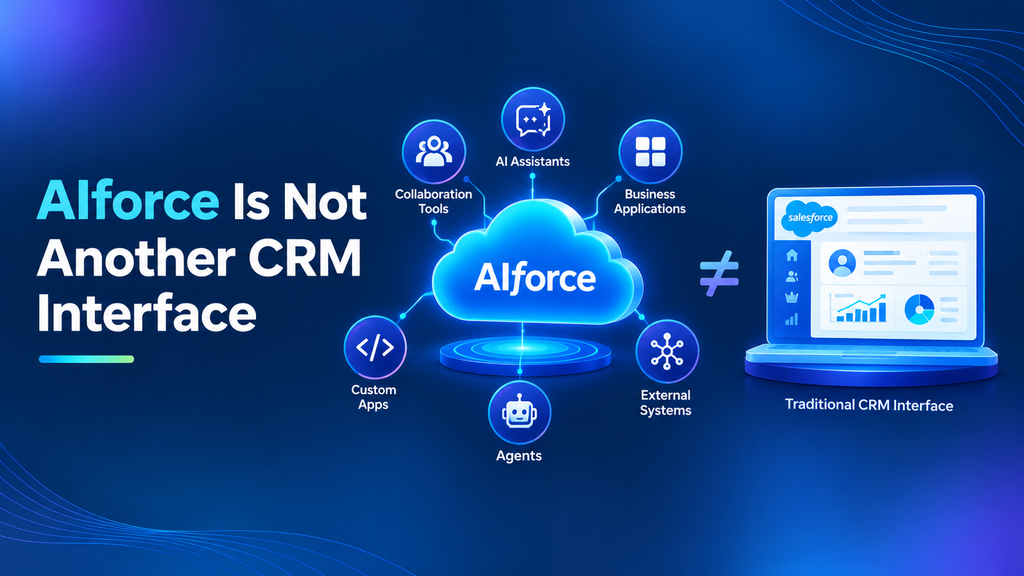
User → Application UI → Business Logic → Data
AIforce moves toward something more flexible:
User or Agent → Interface of Choice → Salesforce Intelligence → Data, Logic, Workflows and Actions
The interface can vary.
The trusted enterprise foundation remains.
That is why Salesforce positions AIforce as a way to bring its capabilities into different AI and application experiences rather than simply creating another destination.
4. From System of Record to Live Enterprise Interface
CRM has traditionally been associated with customer records.
Accounts.
Contacts.
Opportunities.
Cases.
Campaigns.
But enterprise CRM has evolved significantly beyond storing information.
Modern Salesforce environments can contain business rules, workflows, approvals, permissions, automation, customer context, integrations, analytics, and AI capabilities.
The problem is that much of this value can remain trapped behind application boundaries.
AIforce attempts to loosen those boundaries.
Instead of asking employees to constantly navigate toward Salesforce, Salesforce capabilities can increasingly be brought into the environments where work is already happening.
That is a profound shift.
The CRM stops being merely a database with an interface and starts behaving more like an enterprise capability layer.
5. How AIforce Fits Into Salesforce’s Agentic Enterprise
AIforce makes more sense when viewed alongside Salesforce’s broader architecture.
Salesforce describes its Agentic Enterprise architecture through several complementary layers. Salesforce
5.1 Data 360: The Context Layer
Data 360 provides unified context across enterprise information.
Salesforce describes it as bringing together harmonized and federated data, metadata, and memory so agents can better understand customers and business situations.
Without reliable context, AI can produce fluent but irrelevant answers.
With contextual data, AI has a better foundation for reasoning.
5.2 Customer 360: The Business Logic Layer
Customer 360 represents the application and semantic intelligence surrounding customer-facing business processes.
This includes the processes, permissions, actions, and business logic that enable work across areas such as sales, service, marketing, and commerce. Salesforce
This is where enterprise-specific knowledge becomes operational.
5.3 Agentforce: The Digital Workforce
Agentforce is Salesforce’s platform for building and running AI agents.
Agents can reason about tasks and take actions according to the context, permissions, and business rules available to them.
In other words:
Agentforce is about the worker.
5.4 AIforce: The Interface Layer
AIforce extends the foundation outward.
It makes Salesforce capabilities available through different interfaces and experiences.
So a simplified model looks like this:
Data 360 → Context
Customer 360 → Business intelligence
Agentforce → Agents
AIforce → Interfaces
Together, these pieces create a more composable architecture for enterprise AI.
6. How AIforce Actually Works
AIforce is powered by what Salesforce calls its Headless Toolkit.
This includes technologies such as Salesforce MCP servers, APIs, skills, plug-ins, developer tools, and other mechanisms for bringing Salesforce capabilities into external or custom experiences. Salesforce
The concept of “headless” is important.
A headless architecture separates the underlying capabilities from a fixed presentation layer.
That means Salesforce functionality can potentially be surfaced through:
- AI assistants
- Collaboration platforms
- Custom applications
- Agentic interfaces
- Internal tools
- Developer-built experiences
- Conversational workflows
The enterprise foundation remains connected to Salesforce.
The interface becomes flexible.
7. The Role of MCP, APIs, and Developer Tools
AIforce would not be possible through traditional point-to-point integrations alone.
Salesforce is increasingly using modern connectivity mechanisms such as Model Context Protocol (MCP), APIs, skills, and developer tooling to make Salesforce capabilities accessible to AI clients and applications. Salesforce Developers
This matters because AI systems need more than raw data.
They need context.
They need action.
They need permissions.
They need business rules.
And they need ways to interact with enterprise systems safely.
That is where the underlying Salesforce architecture becomes particularly valuable.
8. What “Headless Salesforce” Really Means
Headless Salesforce does not mean Salesforce disappears.
It means Salesforce is no longer dependent on a single interface.
Imagine a sales executive asking an AI assistant:
“Which strategic accounts are showing declining engagement?”
The ideal experience should not require the executive to manually open Salesforce, navigate reports, filter records, inspect activities, and compile the answer.
The intelligence should come to the user.
That is the philosophy behind the headless model.
Salesforce provides the trusted data, rules, actions, identity, and governance while another interface handles the interaction.
9. AIforce and Salesforce in Claude
One of the clearest examples is Salesforce in Claude.
Salesforce’s AIforce materials describe Claudeforce as bringing Salesforce into Claude through a Salesforce MCP server and prebuilt sales skills. Salesforce
This can allow users to interact with Salesforce information and workflows through Claude rather than constantly switching applications.
For example, a sales professional could work through an AI conversation to:
- Research accounts
- Review pipeline
- Prepare account plans
- Analyze opportunities
- Surface relevant customer context
Salesforce’s developer workshop specifically demonstrates Salesforce-connected workflows in Claude and the AIforce Playground. Salesforce Developers
This is a useful glimpse into where enterprise productivity is heading.
10. AIforce and Slackforce
Slack is another major example.
Salesforce describes Slackforce as a live, collaborative interface for Salesforce that brings Salesforce context and intelligence into conversations and workflows.
This is significant because many business decisions already happen in collaboration environments.
Teams discuss deals.
They escalate customer issues.
They review campaign performance.
They coordinate internal actions.
If CRM context can appear inside those conversations, the distance between discussion and execution becomes much smaller.
That could eliminate a surprising amount of operational friction.
11. AIforce and Agentforce Coworker
Agentforce Coworker represents another angle.
Salesforce describes it as an AI teammate that can reason across accounts, activities, and history while operating within existing Salesforce permissions and business rules.
This illustrates an important distinction.
AIforce does not replace Agentforce.
Instead, AIforce can provide the environment through which agents and Salesforce capabilities become accessible.
Think of it this way:
Agentforce performs work. AIforce helps bring that work into the right interface.
12. Building Custom AIforce Experiences
AIforce is not limited to Salesforce-created experiences.
The Headless Toolkit is designed to allow developers to create their own experiences using Salesforce MCP, APIs, developer tools, and AI capabilities. Salesforce
Salesforce’s developer workshop demonstrates this direction through React applications, MCP servers, Headless Experience Layer components, and external clients. Salesforce Developers
That opens the door to highly specialized enterprise experiences.
A manufacturing company could build an operations dashboard.
A financial services organization could create an advisor workspace.
A retailer could build an AI-powered merchant console.
The CRM becomes the intelligence foundation rather than the visible boundary.
13. Why Enterprise CRM Is Becoming Interface-Agnostic
Enterprise users do not really care which application owns the data.
They care about getting the right answer and completing the right action.
That sounds obvious, but enterprise architecture has historically made this surprisingly difficult.
AI changes the equation.
If an employee can ask one intelligent interface to retrieve customer information, interpret it, recommend an action, and execute an approved workflow, the traditional application-centric model begins to look cumbersome.
AIforce is Salesforce’s response to that changing paradigm.
The CRM becomes interface-agnostic.
14. AIforce and Customer Data
AI is only as useful as its context.
A language model can generate an impressive response, but an enterprise requires more than eloquence.
It requires accuracy.
Salesforce positions Data 360 as the context foundation that brings together data, metadata, and memory for agents. Salesforce
That makes data architecture a critical prerequisite.
Businesses looking to capitalize on AIforce should therefore ask:
- Is customer data unified?
- Are important records accurate?
- Are data relationships well defined?
- Are business definitions consistent?
- Are permissions properly designed?
- Can AI access the right context without exposing restricted information?
AIforce does not eliminate these questions.
It makes them more important.
15. Security, Identity, and Governance
Enterprise AI cannot be treated like consumer experimentation.
A useful AI assistant that exposes confidential customer information is not useful.
It is a liability.
Salesforce emphasizes that AIforce experiences can inherit Salesforce identity, permissions, security, and governance.
That is one of the strongest enterprise arguments for the architecture.
The goal is not simply to make Salesforce data accessible.
It is to make it accessible within the appropriate boundaries.
For large organizations, this means governance needs to be designed alongside AI adoption rather than bolted on afterward.
16. What AIforce Means for Sales Teams
Salespeople spend considerable time searching for information.
AIforce could reduce that friction.
Instead of navigating several screens to understand an account, sellers could interact with customer context through an AI interface.
Potential use cases include:
- Account research
- Pipeline analysis
- Opportunity summaries
- Next-best actions
- Account planning
- Sales forecasting support
- CRM updates
- Follow-up preparation
The larger opportunity is not merely saving clicks.
It is reducing the cognitive overhead surrounding sales work.
17. What AIforce Means for Customer Service
Service teams operate in environments where context matters enormously.
An agent handling a customer issue may need:
- Customer history
- Previous cases
- Orders
- Product information
- Account status
- Entitlements
- Internal policies
- Recommended actions
If that context can be surfaced conversationally, service professionals spend less time hunting through systems.
AIforce could therefore contribute to a more contextual, less fragmented service experience.
The future service console may not always look like a console.
18. What AIforce Means for Marketing
Marketing teams are also likely to benefit.
Imagine an AI interface that can reason across customer data, campaign activity, segmentation, engagement history, and business rules.
Instead of simply producing a report, the system could help answer questions such as:
- Which segments are under-engaged?
- Which customers are showing buying signals?
- Which campaigns are contributing to pipeline?
- Which audiences should be prioritized?
- What action should happen next?
The quality of those answers will depend heavily on data quality and governance.
But the interface itself could become dramatically more conversational and adaptive.
19. What AIforce Means for IT and Developers
For developers, AIforce signals a broader architectural shift.
The question is no longer simply:
“How do we integrate Salesforce with this application?”
It becomes:
“How do we expose the right Salesforce capabilities to this application, agent, or interface while preserving enterprise controls?”
That is a much more strategic question.
Developers can potentially use APIs, MCP servers, skills, and other tools to build experiences around existing Salesforce capabilities rather than duplicating business logic in every application.
This could reduce architectural duplication over time.
20. AIforce and the Future of Enterprise Applications
AIforce points toward a world where enterprise applications become less visually defined and more capability-driven.
Today:
Open application → Find record → Read information → Take action
Tomorrow:
Ask → Understand → Decide → Act
The application may still exist.
But it becomes infrastructure beneath the experience.
This is one reason AIforce deserves attention beyond the Salesforce ecosystem. It reflects a larger transformation taking place across enterprise software.
21. The Business Benefits of AIforce
The potential benefits extend beyond convenience.
Reduced context switching
Employees can interact with Salesforce capabilities from tools they already use.
Faster decision-making
Relevant information can be surfaced instead of requiring users to search for it.
Better productivity
AI can assist with research, analysis, workflows, and repetitive actions.
Greater reuse of Salesforce investment
Organizations can potentially make more use of the data, logic, and workflows they have already built.
More composable applications
Developers can build experiences around existing Salesforce capabilities rather than recreating them from scratch.
Stronger AI governance
Enterprise AI interactions can remain connected to established identity, permissions, and governance mechanisms.
These advantages are compelling – but they are not automatic.
22. Challenges Enterprises Should Consider
AIforce does not magically fix a poorly designed Salesforce environment.
In fact, it may expose existing weaknesses more quickly.
Organizations should pay attention to:
Data quality: AI cannot reason reliably over inconsistent data.
Architecture: Complex legacy customizations may complicate modernization.
Permissions: Broader AI access makes identity architecture increasingly important.
Governance: Organizations need clear rules around what agents can see and do.
Integration debt: Old point-to-point integrations may need rethinking.
User adoption: Employees still need to understand how to work effectively with AI.
The organizations that benefit most will likely be those that treat AIforce as an architectural transformation rather than another feature to activate.
23. How Businesses Should Prepare for AIforce
A sensible preparation strategy starts with fundamentals.
1. Audit your Salesforce data
Identify duplication, outdated records, inconsistent definitions, and missing relationships.
2. Review permissions
Understand who—and eventually which agents—can access which information.
3. Map business processes
Identify the workflows where AI could meaningfully reduce friction.
4. Identify high-value use cases
Start with business outcomes rather than technology demonstrations.
5. Review integrations
Determine where Salesforce needs to exchange information with external applications and AI platforms.
6. Establish AI governance
Define acceptable use, human oversight, action permissions, and monitoring.
7. Prepare developers
Teams should understand APIs, MCP, headless architecture, AI integrations, and Salesforce’s evolving developer ecosystem.
Salesforce’s current AIforce learning path explicitly covers the Headless Toolkit, MCP, APIs, data foundations, security, governance, and agentic application development.
24. AIforce vs Agentforce: What Is the Difference?
This is one of the most common questions.
The easiest distinction is:
Agentforce = agents that perform work.
AIforce = the layer that brings Salesforce capabilities into different interfaces and environments.
Agentforce focuses on building and running AI agents.
AIforce focuses on making Salesforce data, logic, workflows, and capabilities available wherever people and agents work.
They are complementary rather than competing products.
25. AIforce vs Traditional Salesforce Integrations
Traditional integration often means connecting two systems for a particular use case.
For example:
Salesforce → Middleware → Application
That approach remains valuable.
But AIforce introduces a more flexible model in which Salesforce capabilities can be exposed through modern interfaces, AI clients, MCP servers, APIs, and developer-built experiences.
The strategic difference is subtle but significant.
Traditional integrations connect systems.
AIforce aims to make enterprise capabilities composable across experiences.
26. The Future of CRM Is Becoming Composable
The next generation of CRM will not be defined only by dashboards, objects, fields, and screens.
It will be defined by context.
Intelligence.
Actions.
Trust.
And accessibility.
AIforce is a significant signal in that direction.
Salesforce has spent decades accumulating enterprise data, business processes, metadata, permissions, automation, and customer context.
The next challenge is making all of that intelligence available wherever work happens.
AIforce is essentially an attempt to unlock that accumulated value.
The implications are substantial.
The CRM may no longer be the place employees go to do work.
The CRM may become the intelligence that follows them wherever the work happens.
27. Frequently Asked Questions About Salesforce AIforce
1. What is Salesforce AIforce?
AIforce is Salesforce’s live interface layer for bringing Salesforce data, workflows, business logic, permissions, and intelligence into different AI interfaces, applications, and work environments.
2. Is AIforce a Salesforce product?
AIforce is best understood as an architectural and experience layer rather than a traditional standalone CRM application. Salesforce describes it as an approach for making Salesforce capabilities available across different interfaces.
3. Is AIforce the same as Agentforce?
No. Agentforce focuses on AI agents that can perform tasks and take actions. AIforce focuses on making Salesforce capabilities accessible through different interfaces and experiences.
4. What happened to Headless 360?
Salesforce rebranded Headless 360 as AIforce on September 4, 2026. Salesforce stated that the underlying functionality and content remained unchanged during the transition.
5. What technologies power AIforce?
AIforce uses technologies and tools including Salesforce MCP servers, APIs, skills, plug-ins, and developer tooling.
6. Can AIforce work with Claude?
Yes. Salesforce provides Salesforce in Claude as an AIforce experience, using a Salesforce MCP server and prebuilt sales capabilities.
7. Can AIforce work with Slack?
Yes. Slackforce is one of Salesforce’s AIforce experiences, designed to bring Salesforce context and intelligence into Slack conversations and workflows.
8. Can developers build custom AIforce experiences?
Yes. Salesforce’s Headless Toolkit is designed to support custom experiences using MCP, APIs, developer tools, and other capabilities.
9. Does AIforce replace Salesforce?
No. AIforce extends the reach of Salesforce rather than replacing its core platform. The objective is to make Salesforce capabilities available beyond the traditional Salesforce interface.
10. Is AIforce secure for enterprise use?
Salesforce positions AIforce around existing Salesforce identity, permissions, security, and governance mechanisms. However, enterprises still need to design and manage their own data, access, and AI governance strategies.
11. Does AIforce require Data 360?
Data 360 is an important part of Salesforce’s broader Agentic Enterprise architecture because it provides unified customer and business context. However, the exact capabilities available in an AIforce implementation depend on the specific Salesforce architecture, products, data, and use case.
12. Why is AIforce important for the future of CRM?
Because it moves CRM beyond a fixed application interface. AIforce represents a model in which Salesforce data, intelligence, workflows, and business logic can be accessed wherever people and AI agents work.
28. Final Thoughts: Is AIforce the Future of Enterprise CRM?
AIforce is more than another Salesforce announcement.
It represents a change in how enterprise software can be consumed.
For years, companies invested in Salesforce to centralize customer data, automate workflows, standardize processes, and create a reliable operational foundation.
Now the opportunity is to make that foundation available beyond the Salesforce screen.
That could mean Salesforce inside Claude.
Salesforce inside Slack.
Salesforce inside custom applications.
Salesforce inside agentic workflows.
And potentially Salesforce capabilities appearing wherever the next generation of enterprise work takes place.
The real competitive advantage, however, will not come from simply adopting AIforce.
It will come from having the data architecture, governance, integrations, business processes, and CRM strategy required to make AI genuinely useful.
That is where enterprise readiness becomes decisive.
Ready to Prepare Your Salesforce Environment for the Agentic Enterprise?
AIforce is changing the conversation from “How do we add AI to CRM?” to “How do we make CRM intelligence available everywhere our business operates?”
For enterprises evaluating Salesforce AI, Agentforce, Data 360, headless architecture, integrations, and intelligent automation, the right strategy begins with understanding the existing ecosystem – and identifying where AI can create measurable business value.
STRAT-LINK helps organizations navigate Salesforce transformation, AI, digital experience, cloud, cybersecurity, and technology modernization with a business-first approach.
If your organization is preparing for the next generation of Salesforce and enterprise AI, connect with STRAT-LINK to explore how your CRM architecture can evolve from a system of record into an intelligent, connected business platform.
STRAT-LINK – Building technology strategies for the enterprise of tomorrow.