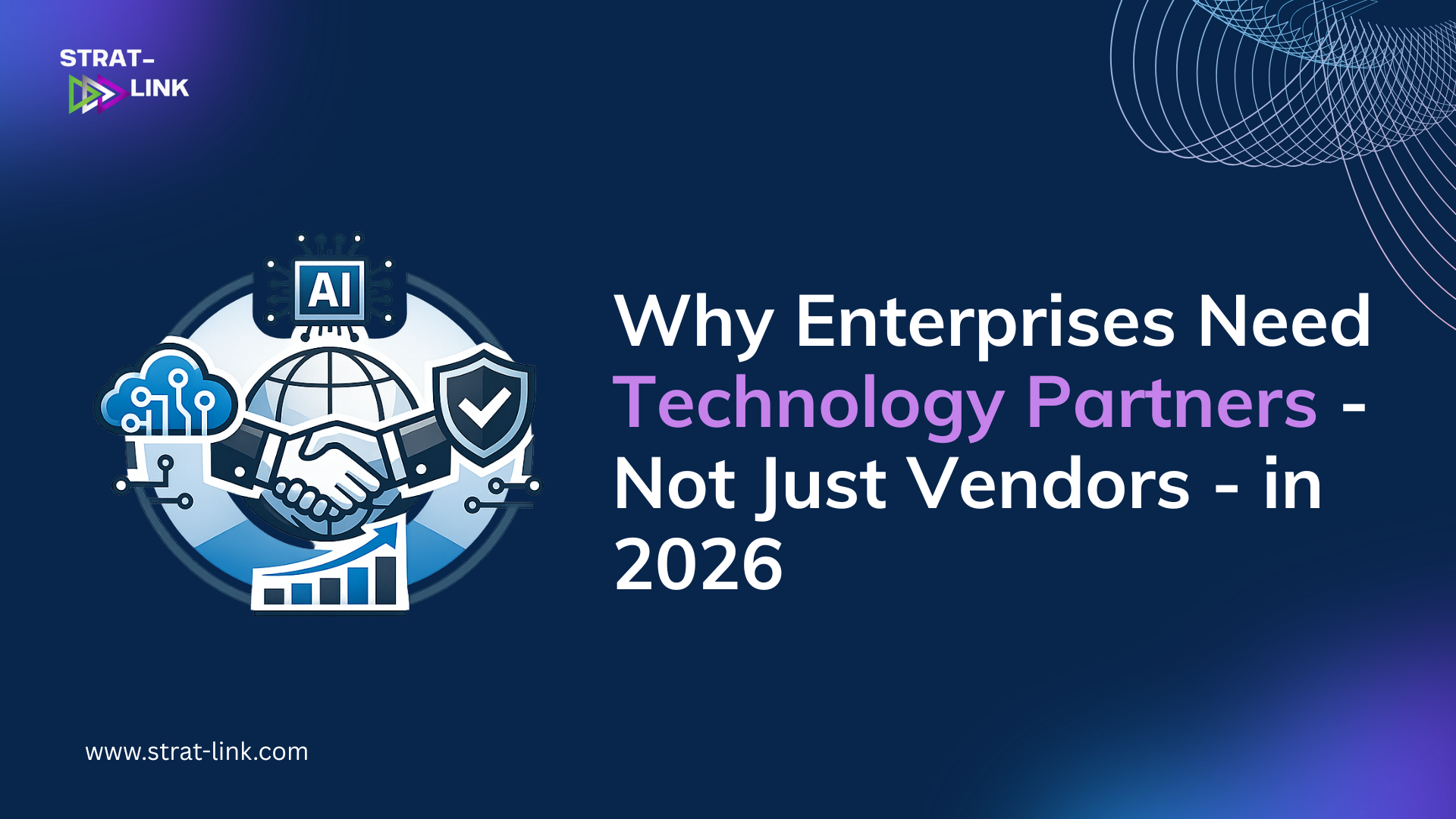
Why Enterprises Need Technology Partners – Not Just Vendors – in 2026
Introduction: The Shift from Vendor Relationships to Strategic Partnerships
Enterprise technology has entered a new era.
Not long ago, organizations primarily looked for vendors that could deliver software licenses, build applications, or complete implementation projects on time and within budget. Success was measured by whether a project was delivered according to scope.
That approach is no longer enough.
In 2026, technology is no longer a support function – it is the engine that drives business growth, customer experience, operational efficiency, and competitive differentiation. Artificial intelligence is reshaping workflows. Cloud ecosystems continue to evolve. Cybersecurity threats grow more sophisticated every day. Customer expectations change faster than most businesses can adapt.
Against this backdrop, enterprises need more than suppliers.
They need trusted advisors who understand business strategy as deeply as they understand technology. They need organizations that can anticipate challenges, recommend improvements, scale resources quickly, and continuously optimize digital investments.
In other words, they need technology partners – not just vendors.
The distinction may sound subtle, but it can determine whether a digital transformation initiative succeeds or fails.
Why 2026 Is a Defining Year for Enterprise Technology
Technology has always evolved rapidly, but the pace of innovation over the past few years has been unprecedented.
Organizations are simultaneously investing in:
- Artificial Intelligence
- Generative AI
- Intelligent Automation
- Salesforce Agentforce
- Customer Data Platforms
- Oracle Cloud
- Digital Experience Platforms
- Cybersecurity
- Cloud Migration
- Data Analytics
Each investment creates new opportunities – but also introduces greater complexity.
Businesses can no longer afford disconnected technology decisions.
Instead, they need strategic guidance that aligns every investment with measurable business outcomes.
This is precisely where technology partnerships become indispensable.
Understanding the Difference Between a Vendor and a Technology Partner
What Is a Technology Vendor?
A vendor delivers products or services.
Their responsibility typically ends once the agreed deliverables have been completed.
For example, a vendor may:
- Build a CRM implementation
- Deliver software licenses
- Complete website development
- Configure an ERP system
While these activities are important, they usually focus on execution rather than long-term business success.
A vendor asks:
“What do you want us to build?”
What Is a Technology Partner?
A technology partner operates differently.
Rather than simply executing instructions, they collaborate with your organization to solve business challenges.
They ask questions like:
- What business problem are you trying to solve?
- Is this the best technology for your goals?
- How will this scale in three years?
- How will AI impact this implementation?
- What cybersecurity risks should be addressed?
- How will employees adopt this solution?
Technology partners think strategically before they think technically.
Their success is measured by your business outcomes – not just project completion.
Why the Difference Matters
Digital transformation is rarely a one-time initiative.
It is a continuous journey involving:
- Technology upgrades
- AI adoption
- Cloud migrations
- Platform optimization
- Security improvements
- Employee enablement
- Customer experience enhancements
A vendor completes projects.
A technology partner helps businesses evolve.
That distinction has become more important than ever.
The New Reality of Enterprise Digital Transformation
Enterprise transformation has become dramatically more complex than it was just a few years ago.
A single customer interaction may involve multiple enterprise platforms working together.
For example:
- Salesforce manages customer relationships.
- Oracle powers financial operations.
- Sitecore delivers digital experiences.
- AI personalizes recommendations.
- Data Cloud unifies customer information.
- Cybersecurity tools protect every interaction.
If one component fails, the customer experience suffers.
Organizations therefore need partners capable of understanding the entire ecosystem rather than isolated technologies.
This holistic perspective separates strategic technology partners from traditional implementation vendors.
Why Traditional Vendor Relationships Are No Longer Sufficient
Technology Is Changing Faster Than Ever
Today’s enterprise technology landscape evolves almost monthly.
New Salesforce releases introduce AI capabilities.
Oracle continuously expands its cloud portfolio.
Sitecore is reshaping digital experience management.
Generative AI is transforming business processes.
Cybersecurity frameworks evolve constantly.
A vendor focused solely on project delivery may struggle to keep pace with these rapid changes.
Technology partners invest continuously in innovation because their relationship extends well beyond implementation.
Artificial Intelligence Is Transforming Every Business Function
AI is not simply another software feature.
It fundamentally changes how organizations operate.
Sales teams use AI agents to qualify leads.
Marketing departments automate content personalization.
Customer service teams deploy intelligent assistants.
Finance departments leverage predictive analytics.
Operations rely on autonomous workflows.
Successfully adopting AI requires strategic planning, governance, security, training, and ongoing optimization.
These responsibilities extend far beyond traditional implementation services.
Business Expectations Have Changed
Technology investments are no longer judged solely by technical performance.
Executives expect measurable business value.
They ask questions such as:
- How much revenue did this generate?
- Did customer satisfaction improve?
- Was operational efficiency increased?
- Did costs decrease?
- How quickly was ROI achieved?
Technology partners focus on answering these questions.
Vendors typically focus on delivering technical requirements.
The Biggest Challenges Enterprises Face in 2026
Talent Shortages
Demand for experienced Salesforce consultants, Oracle architects, Sitecore developers, AI specialists, cybersecurity professionals, and cloud engineers continues to exceed supply.
Recruitment cycles are becoming longer.
Projects cannot wait.
Technology partners provide immediate access to experienced specialists while helping organizations build long-term capability.
Legacy Systems Continue to Slow Innovation
Many enterprises still rely on legacy applications that were never designed for today’s cloud-first, AI-powered world.
These systems create:
- Technical debt
- Integration complexity
- Security vulnerabilities
- High maintenance costs
Technology partners develop modernization roadmaps that reduce risk while protecting existing investments.
Cybersecurity Threats Are Becoming More Sophisticated
Cybercrime has evolved dramatically.
AI-powered phishing.
Ransomware.
Supply-chain attacks.
Identity theft.
Deepfake fraud.
Zero-day exploits.
Technology partners integrate cybersecurity into every phase of digital transformation rather than treating it as a separate initiative.
Data Silos Limit Business Intelligence
Most organizations possess enormous amounts of data.
Unfortunately, much of it remains isolated across multiple systems.
Disconnected data limits AI capabilities, reporting accuracy, and customer insights.
Technology partners help create unified data strategies that unlock enterprise-wide intelligence.
Budget Pressure Demands Smarter Investments
Economic uncertainty means technology leaders must justify every investment.
Rather than purchasing more software, organizations increasingly seek maximum value from existing platforms.
Technology partners optimize technology ecosystems instead of simply recommending additional products.
How Technology Partners Create Long-Term Business Value
Strategic Consulting Beyond Implementation
The best technology partners begin every engagement by understanding business objectives.
Instead of asking which software you want, they ask what outcomes you want to achieve.
This consultative mindset often uncovers opportunities that organizations hadn’t considered.
Technology becomes a business enabler rather than merely an operational tool.
Accelerating Innovation
Innovation requires more than creativity.
It requires experience.
Technology partners bring insights from multiple industries, helping organizations avoid common mistakes while adopting proven best practices.
This dramatically shortens learning curves.
It also accelerates digital transformation.
Reducing Business Risk
Every enterprise technology project carries risk.
Missed deadlines.
Integration failures.
Low user adoption.
Security vulnerabilities.
Compliance issues.
Experienced partners anticipate these challenges before they become costly problems.
Risk mitigation becomes part of project planning rather than an afterthought.
Improving Technology Adoption
Even the most sophisticated technology delivers little value if employees fail to use it effectively.
Technology partners invest in:
- User training
- Change management
- Executive alignment
- Process optimization
- Continuous improvement
Successful adoption becomes a shared responsibility.
Technology Partners vs Vendors: A Detailed Comparison
At first glance, technology vendors and technology partners may appear to offer similar services. Both provide software expertise, implementation support, and technical resources. However, their approach, objectives, and long-term impact on your business are fundamentally different.
| Technology Vendor | Technology Partner |
| Focuses on delivering products or services | Focuses on achieving business outcomes |
| Relationship is typically project-based | Relationship is long-term and strategic |
| Executes predefined requirements | Challenges assumptions and recommends better solutions |
| Success is measured by project completion | Success is measured by business growth and ROI |
| Reactive approach | Proactive and consultative approach |
| Limited involvement after delivery | Provides continuous optimization and innovation |
| Solves technical issues | Solves business challenges using technology |
| Supports implementation | Supports transformation, adoption, and future growth |
The distinction becomes increasingly important as enterprises embrace AI, cloud computing, cybersecurity, and intelligent automation. Today’s organizations need advisors who understand both business strategy and technology – not simply vendors who execute predefined tasks.
The Role of Technology Partners Across Enterprise Platforms
Salesforce: Driving Intelligent Customer Experiences
Salesforce has evolved far beyond a traditional CRM. It has become an intelligent business platform encompassing Sales Cloud, Service Cloud, Marketing Cloud, Experience Cloud, Data Cloud, Revenue Cloud, MuleSoft, and Agentforce.
Successfully leveraging this ecosystem requires more than technical implementation.
A technology partner helps organizations:
- Design scalable Salesforce architectures
- Implement Salesforce Agentforce effectively
- Build AI-powered customer journeys
- Integrate Salesforce with enterprise applications
- Improve user adoption
- Optimize platform performance
- Continuously innovate with each Salesforce release
Rather than simply deploying Salesforce, a strategic partner ensures it becomes a competitive advantage.
Oracle: Modernizing Enterprise Operations
Oracle continues to play a critical role in enterprise resource planning, finance, supply chain management, human capital management, and database technologies.
Oracle transformations are rarely simple.
Organizations often manage:
- ERP modernization
- Oracle Cloud migrations
- Oracle Fusion implementations
- Database modernization
- Financial transformation
- Supply chain optimization
Technology partners bring proven methodologies, governance frameworks, and industry best practices that significantly reduce implementation risks while accelerating business value.
Instead of viewing Oracle as an IT initiative, they position it as a business transformation platform.
Sitecore: Delivering Exceptional Digital Experiences
Today’s customers expect personalized, seamless, and consistent digital experiences.
Sitecore enables organizations to create those experiences through content management, personalization, customer data, and digital commerce capabilities.
A technology partner helps organizations:
- Migrate to Sitecore XM Cloud
- Build headless architectures
- Improve website performance
- Optimize customer journeys
- Enhance personalization strategies
- Integrate Sitecore with CRM and marketing platforms
The result is not simply a better website – it is a better digital experience that strengthens customer relationships.
Artificial Intelligence and Intelligent Automation
Artificial intelligence has become the defining technology of 2026.
However, AI implementation is not simply about deploying new tools.
Organizations need guidance on:
- AI strategy
- Governance
- Responsible AI
- Security
- Data readiness
- Process redesign
- Workforce enablement
Technology partners help enterprises identify practical AI use cases that deliver measurable business outcomes instead of pursuing AI for the sake of innovation.
Whether implementing Salesforce Agentforce, intelligent automation, predictive analytics, or generative AI, strategic guidance becomes invaluable.
Cybersecurity: Building Trust in a Digital World
Every digital transformation initiative introduces new security considerations.
Cloud platforms.
AI.
Remote work.
Connected devices.
Third-party integrations.
These innovations expand the attack surface.
Technology partners incorporate cybersecurity into every stage of transformation by helping organizations implement:
- Zero Trust Architecture
- Identity and Access Management
- Security Monitoring
- Threat Detection
- Compliance Frameworks
- Data Protection Strategies
Security is no longer an afterthought.
It becomes part of business strategy.
Characteristics of a Great Technology Partner
Not every technology provider deserves to be called a partner.
Exceptional technology partners demonstrate several defining characteristics.
They Understand Your Business
Before discussing technology, they seek to understand your industry, customers, challenges, and long-term objectives.
They Think Beyond Today’s Project
Great partners plan for scalability.
They design solutions that remain effective as your business grows.
They Continuously Innovate
Technology never stands still.
Neither should your partner.
Leading partners invest heavily in certifications, emerging technologies, AI research, and industry best practices.
They Provide Honest Recommendations
A true partner is willing to recommend against unnecessary technology investments if a simpler solution better serves your business.
Trust outweighs short-term revenue.
They Measure Success by Business Outcomes
Project completion is only the beginning.
Great partners remain engaged to improve adoption, optimize performance, and maximize return on investment.
Questions to Ask Before Choosing a Technology Partner
Choosing the right technology partner is one of the most important strategic decisions an organization can make.
Consider asking questions such as:
- Have they successfully delivered projects similar to ours?
- Do they specialize in Salesforce, Oracle, Sitecore, AI, or cybersecurity?
- Can they scale resources as our business grows?
- What governance methodologies do they follow?
- How do they measure project success?
- What support do they provide after implementation?
- How do they approach AI and emerging technologies?
- How do they ensure cybersecurity throughout projects?
- What industries have they worked with?
- Can they provide strategic consulting in addition to technical delivery?
The answers reveal whether an organization is merely selling services—or investing in your success.
Common Mistakes Businesses Make When Selecting IT Vendors
Many digital transformation projects fail long before implementation begins.
One of the primary reasons is selecting the wrong partner.
Common mistakes include:
Choosing Based Solely on Price
The lowest-cost proposal often becomes the most expensive over time due to delays, rework, and missed business objectives.
Prioritizing Technical Skills Alone
Technical expertise is essential.
However, communication, collaboration, governance, and strategic thinking are equally important.
Ignoring Cultural Fit
Technology partners become extensions of internal teams.
Strong cultural alignment significantly improves collaboration and project success.
Overlooking Industry Experience
Every industry has unique compliance requirements, customer expectations, and operational complexities.
Relevant experience accelerates delivery.
Focusing Only on Implementation
Digital transformation continues long after go-live.
Organizations should prioritize partners capable of supporting continuous optimization and innovation.
The Future of Enterprise Partnerships
Technology partnerships will become even more important during the next decade.
Several trends are driving this evolution:
- AI-first business models
- Autonomous enterprises
- Continuous cloud innovation
- Intelligent automation
- Composable architectures
- Hyper-personalized customer experiences
- Data-driven decision making
- Increasing cybersecurity challenges
Organizations cannot master every emerging technology internally.
Strategic partnerships will become a competitive differentiator.
Why Strategic Partnerships Will Define Business Success
The companies that thrive in 2026 will not necessarily be those with the largest technology budgets.
They will be the organizations that make smarter technology decisions.
Strategic partnerships enable businesses to:
- Innovate faster
- Reduce implementation risks
- Improve customer experiences
- Accelerate digital transformation
- Increase operational efficiency
- Build resilient technology ecosystems
- Respond rapidly to market changes
- Maximize technology investments
Technology alone rarely creates competitive advantage.
The expertise behind it does.
Conclusion
The enterprise technology landscape has fundamentally changed.
Artificial intelligence, cybersecurity, cloud platforms, customer experience, automation, and data are converging into highly interconnected ecosystems that require continuous optimization – not one-time implementation.
In this environment, organizations need more than vendors who complete projects and move on. They need trusted advisors who understand business strategy, anticipate future challenges, and help maximize the value of every technology investment.
Whether implementing Salesforce Agentforce, modernizing Oracle applications, building digital experiences with Sitecore, strengthening cybersecurity, or accelerating AI adoption, the right technology partner becomes an extension of your leadership team.
The question is no longer whether you need external expertise.
The real question is whether your current technology provider is helping your business grow – or simply delivering services.
The future belongs to organizations that build long-term partnerships rooted in innovation, collaboration, and measurable business outcomes.
Partner with STRAT-LINK to Accelerate Your Digital Transformation
Technology investments deliver their greatest value when backed by the right expertise.
At STRAT-LINK, we go beyond implementation. We work alongside your business as a strategic technology partner, helping you navigate digital transformation with confidence, agility, and long-term vision.
From Salesforce, Oracle, and Sitecore solutions to AI-driven innovation, staff augmentation, application development, cloud transformation, and cybersecurity, our experts help organizations build scalable, secure, and future-ready digital ecosystems.
Why Choose STRAT-LINK?
- Certified Salesforce, Oracle, and Sitecore experts
- AI and intelligent automation consulting
- End-to-end digital transformation services
- Flexible staff augmentation models
- Enterprise application development
- Cloud migration and modernization
- Cybersecurity-first implementation approach
- Long-term strategic consulting and managed services
Don’t settle for a vendor who simply delivers technology. Choose a partner committed to delivering measurable business outcomes.
Connect with STRAT-LINK today and transform your technology investments into sustainable business growth.
Frequently Asked Questions
What is the difference between a technology partner and a technology vendor?
A technology vendor primarily provides products or services, while a technology partner works closely with your organization to achieve long-term business goals through strategic guidance, continuous optimization, and innovation.
Why do enterprises need technology partners in 2026?
As technologies like AI, cloud computing, cybersecurity, and intelligent automation become more complex, enterprises need strategic expertise to maximize ROI, reduce risks, and accelerate digital transformation.
How can a technology partner support Salesforce projects?
A technology partner helps with Salesforce implementation, Agentforce adoption, AI integration, Data Cloud, platform optimization, user adoption, and long-term innovation.
Can technology partners help with Oracle modernization?
Yes. They support Oracle Cloud migrations, ERP modernization, Oracle Fusion deployments, database optimization, integration, and ongoing platform enhancements.
Why is Sitecore expertise important for digital transformation?
Sitecore powers personalized digital experiences. Experienced technology partners help organizations implement XM Cloud, improve content management, optimize customer journeys, and integrate Sitecore with enterprise systems.
What industries benefit most from technology partnerships?
Industries such as healthcare, financial services, retail, manufacturing, education, telecommunications, logistics, and the public sector all benefit from strategic technology partnerships.
How do technology partners improve cybersecurity?
They integrate security into every stage of digital transformation through Zero Trust architecture, identity management, compliance, threat monitoring, and secure cloud implementations.
What should businesses look for in a technology partner?
Look for proven expertise, industry experience, strategic consulting capabilities, strong governance, scalable delivery models, security knowledge, and a track record of successful enterprise implementations.
Is a technology partner more cost-effective than working with multiple vendors?
In many cases, yes. A strategic partner reduces project complexity, minimizes delays, improves collaboration, and maximizes technology investments, resulting in a lower total cost of ownership.
How can STRAT-LINK help organizations succeed in 2026?
STRAT-LINK combines deep expertise in Salesforce, Oracle, Sitecore, AI, cybersecurity, cloud technologies, and staff augmentation to help enterprises accelerate innovation, optimize digital investments, and achieve long-term business success.